Image taken from EurekAlert!, credited to Argonne National Laboratory
Greetings, and thanks for checking out my blog! I’m Ashton Petersen, a mechanical engineering major hoping to attend graduate school to pursue research in materials science, specifically in computational materials discovery. This includes the use of computer models, databases, simulations, and, increasingly, artificial intelligence to predict and study new materials before they are made in a lab. This field excites me because it resides at the interface of numerous endeavors: mechanical engineering, chemistry, physics, computer science, and manufacturing. It also showcases that engineering is not only about building machines or structures after materials already exist. Engineers can also help discover the materials that make future technologies possible.
To this end, I consider issues related to computational materials discovery worth exploring publicly because materials affect almost every facet of modern life. Stronger alloys can make aircraft and vehicles safer or lighter. Heat-resistant materials can help with engines, turbines, and spacecraft. Semiconductor materials influence electronics, sensors, and computing. I also understand that the public usually sees only the final product, not the years of research behind it.
This disconnect is why I think following and documenting the role of computational materials discovery in solving big, real-world challenges is an important step in demonstrating its relevance. The Materials Genome Initiative’s list of 2024 research challenges gives several examples of how materials research connects to problems people can actually recognize, discussing challenges such as tissue-like materials for biomedical devices and implants, affordable multifunctional composites, and sustainable materials for semiconductor manufacturing. Materials discovery is not only about inventing something new in a laboratory. It is also about improving medical treatment, reducing emissions from construction, making transportation and aerospace systems lighter, and supporting the electronics that modern society depends on.
This also necessitates exploring and understanding the role of standards, measurement, and reliable data in computational materials discovery, another topic I think is of paramount importance to explore in an era of increasing scientific malpractice and misinformation. The National Institute of Standards and Technology explains that computational materials design can reduce the time and cost of developing new materials by using physics-based models instead of relying only on trial and error. However, a prediction is only useful if researchers can trust the data and test the results. In engineering, it is not enough for a material to look promising in a simulation. It also has to work under real conditions, such as heat, pressure, vibration, corrosion, and repeated loading.
In the AI era, this issue of reliability leads to another important topic for discussion: the role of autonomous laboratories in materials research. Berkeley Lab’s article, “Meet the Autonomous Lab of the Future”, describes the A-Lab, which combines automation, artificial intelligence, and materials science to speed up discovery. Endeavors like this interest me because they show that computational materials discovery increasingly does not stop at computer predictions. The next challenge is figuring out whether predicted materials can actually be synthesized, tested, and used. From a mechanical engineering perspective, this connects to robotics, manufacturing, instrumentation, and experimental design. It also raises public questions: What does it mean for AI to help discover materials? What role do human scientists still play? How do we avoid exaggerating what AI can do while still explaining its real value?
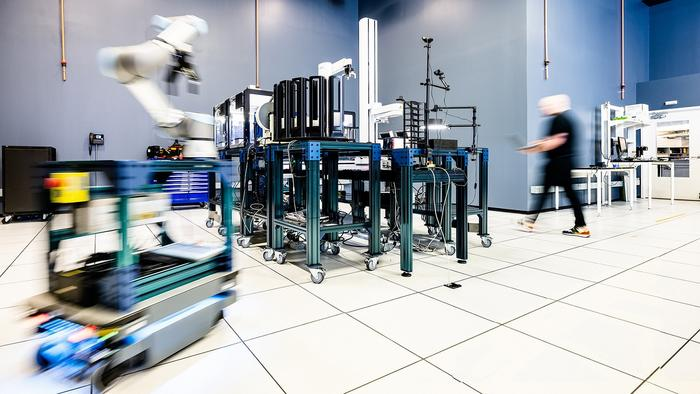
Image taken from EurekAlert!, credited to Argonne National Laboratory
My goal in all of this is to practice translating engineering knowledge into a public genre. For me, accomplishing this with computational materials discovery matters because the future of energy, transportation, electronics, medicine, and space exploration depends on materials that may not exist yet. If us engineers and scientists want the public to understand why this research matters, then we need genres like blogs that can connect specialized knowledge to everyday concerns and disseminate that information to a wider audience.
 Ashton Petersen
Leave a comment