In my last post, I explored the current state of self-driving science, examining some of the enduring risks associated with AI’s usage in the lab. In short, I asked, “Can self-driving AI be trusted?” That question still matters to me, but I recognize that trust isn’t only built in the lab itself. It’s also shaped by how this technology is presented to the public. Early on, a common theme in all the coverage on self-driving labs was the emphasis on how these labs make processes faster, cheaper, and more efficient. However, that same analysis often neglected to address the uncertainty that still surrounds these labs. As such, I decided to look at a public-facing example of how self-driving labs are being explained currently.
I settled on the University of Toronto’s Acceleration Consortium and, specifically, its page explaining what a self-driving lab is. The site describes self-driving labs as a coming paradigm shift in how materials and molecules will be discovered going forward. That said, the site manages to avoid reading like a dense academic paper, working more like a polished science communication website. I was impressed with its consistent use of short sections, clean visuals, and simple explanations. The site makes a novel and what should be intimidated field feel understandable.
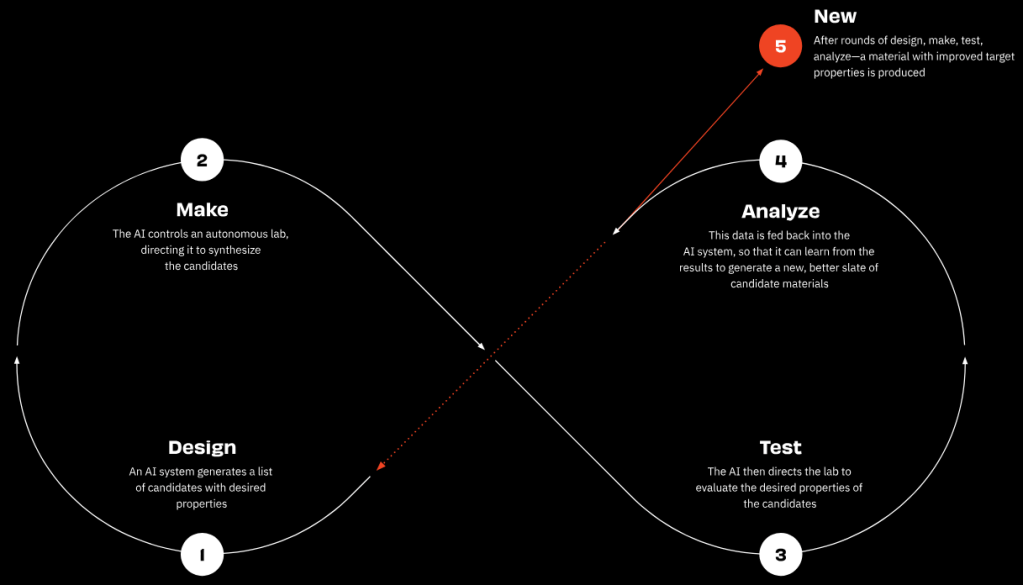
Funnily enough, this recognition of how intimidating the topic should be is exactly what makes the website so effective in explaining it. A self-driving lab isn’t just a robot doing chemistry or similar research. More precisely, it’s a closed-loop system where an AI model suggests an experiment, automated instruments carry it out, sensors collect data, and the system uses that data to decide what should happen next. Yet, by reading the Acceleration Consortium, you’d almost get the impression that the whole research process boils down to a simple cycle of designing, making, testing, and analyzing–somehow producing astonishing results.
The website’s ability to connect self-driving labs to real-world problems is impressive, but this is also where its optimism deserves the most scrutiny. The idea of getting self-driving labs to make progress on problems like carbon capture and water filtration is important, but these are also incredibly complex issues. While the site presents self-driving labs as tools that could help make progress in these areas, it doesn’t always distinguish how novel some of that progress still is. The challenge isn’t only discovering promising materials but also making them easy to manufacture and, more importantly, practical to use.

Image taken from the ACS publication “Self-Driving Laboratories: Translating Materials Science from Laboratory to Factory”
This is where the website could be stronger. It introduces the promise of self-driving labs clearly, but it says less about their limitations. Self-driving labs may be improving, but humans still matter in the research process. Ultimately, scientists still decide which questions are worth asking and whether results make sense. A self-driving lab may be automated, but it still depends on human input.
The Acceleration Consortium gives a fairly robust introduction to self-driving labs. However, while it makes this complex field feel accessible and exciting, its tone borders more toward possibility than caution in doing so. The site would be stronger if it included more discussion of current challenges like those mentioned in my previous blog. It’s a good first read for someone curious about how AI and automation are changing materials discovery, but it’s also a source I would suggest pairing with more critical ones. Self-driving labs may help scientists move faster, but speed alone is not the same as reliability.
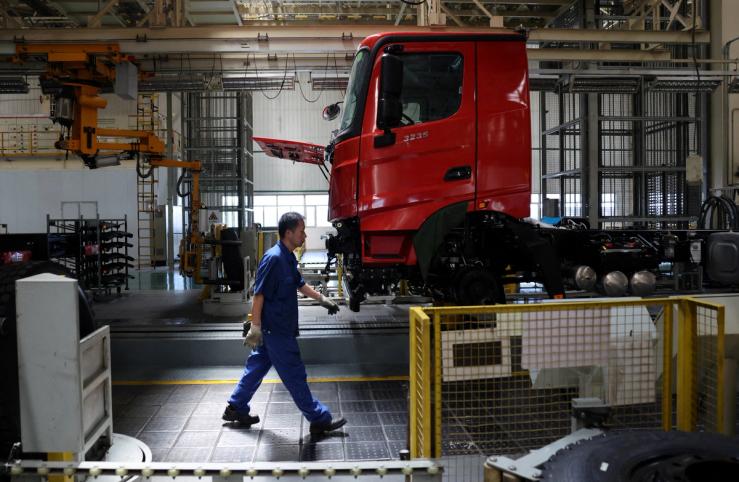
Image taken from Reuters, credited to Maxim Shemetov
 Ashton Petersen
Leave a comment