A Style Guide for Mechanical Engineering Writing
Introduction to the Style Guide
Throughout this blog, I’ve explored how engineers and materials scientists communicate emerging technologies, particularly in autonomous laboratories and materials discovery. Building on a technical guide I made previously to accomplish this, today I want to share a formal style guide I’ve developed which outlines effective practices for laboratory reports, research papers, design memoranda, proposals, instructions, and presentations in the field of mechanical engineering– my field of study.
I’ve designed this guide primarily for engineering students and early-career professionals developing their technical communication skills. Such skills are important because effective engineering writing helps readers evaluate evidence and reproduce procedures, a sentiment echoed by the ASME, NASA, and Purdue OWL (American Society of Mechanical Engineers [ASME], n.d.; NASA Scientific and Technical Information Program, n.d.; Purdue Online Writing Lab, n.d.).
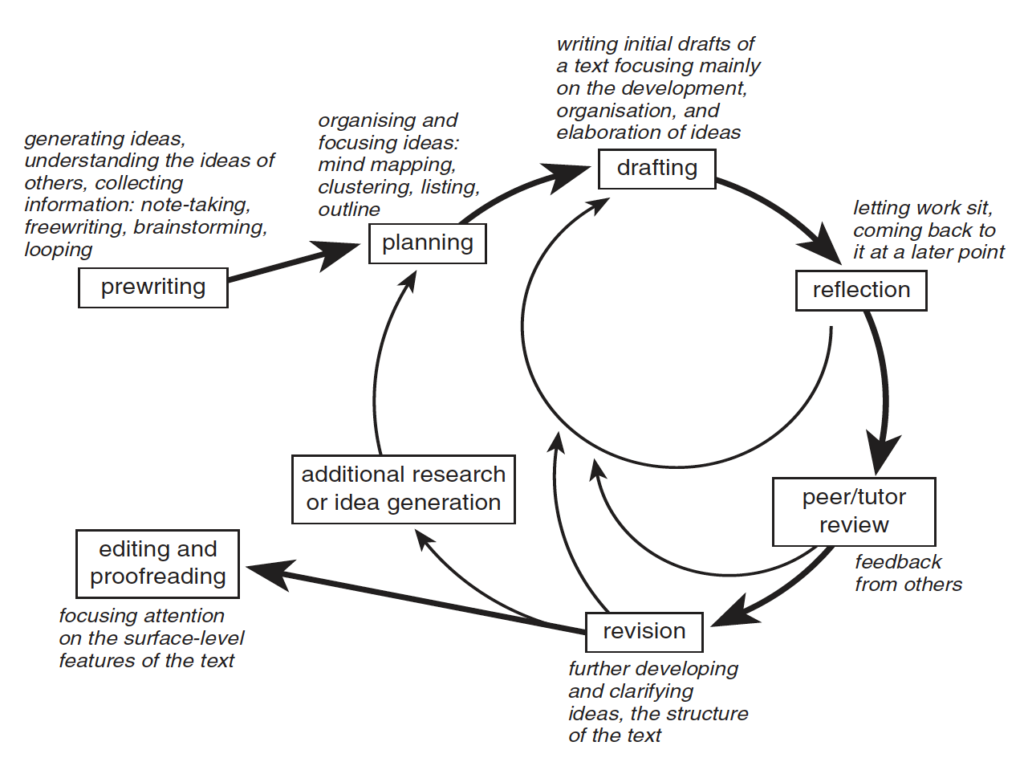
Presentation of Genre Features
| Engineering genre | Main purpose | Likely audience | Most important features |
| Research paper | Present original findings | Researchers and specialists | Methods, evidence, uncertainty, contribution |
| Technical report | Document an investigation or project | Engineers, managers, clients, regulators | Scope, procedures, results, conclusions |
| Design memorandum | Support a design decision | Project team or supervisor | Requirements, alternatives, calculations, trade-offs |
| Procedure or guide | Help someone complete a task | Operators, students, technicians | Ordered steps, warnings, diagrams, verification |
| Proposal | Obtain approval, funding, or resources | Managers, clients, sponsors | Need, objectives, plan, feasibility, cost |
1. Begin with Purpose, Audience, and Decision
Before writing, decide what the document needs to accomplish and who the intended audience or user is, as that will dictate the level of detail the document must provide. A test report may show whether a material meets requirements, while a design memo may recommend the best option. Keeping the main decision in focus prevents the document from becoming a list of calculations without a clear point.
The structure of the document should also match the document’s purpose. If it’s a research paper, it should follow an introduction, methods, results, and discussion format. Alternatively, a design report may go over requirements, alternatives, analysis, selection, and implementation. Additionally, a procedure usually includes materials, numbered steps, warnings, troubleshooting, and verification. Regardless of which genre you choose though, ASME also recommends clear titles, abstracts, references, figures, tables, and supporting material (ASME, n.d.). The goal is to choose a structure that helps the reader.

2. Present Technical Content That Can Be Checked
Explain how results were produced by identifying the materials, equipment, software, assumptions, and test conditions. Define symbols, use units consistently, and place lengthy calculations in an appendix.
The NIST report Mechanical Properties Testing for Metal Parts Made via Additive Manufacturing provides an effective example of putting these steps into practice because it clearly defines its scope and groups tests by the properties they measure. By separating deformation and failure tests, it helps the readers understand the purpose of each method (Slotwinski et al., 2012).
Writers should also distinguish between observation, interpretation, and recommendation. For example, noting that temperature rose as flow decreased is an observation; explaining that this may indicate reduced heat removal is an interpretation; recommending a minimum flow rate is a decision. Keeping these steps separate makes the reasoning easier to follow.
3. Organize Information in Layers
Engineering readers often scan documents before reading closely. That’s why the use of defining characteristics such as titles, headings, captions, and the like are so important to include. These tools can help readers find the information they need in an expedient fashion.
By extension, sections like the Abstract should briefly explain the problem, approach, key result, and significance. The body can then provide supporting details. This layered structure saves time for general readers while preserving the technical depth specialists need.
4. Use Visuals as Evidence
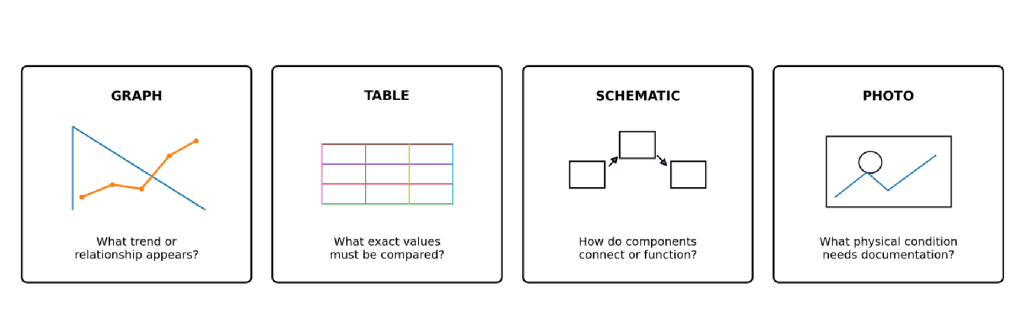
Mechanical engineers rely on visuals to make technical information easier to understand. They use graphs to highlight trends, tables to organize values, schematics or CAD images to show the components of something and/or how it’s built–the list goes on. The important thing is that–whatever format you choose–you keep it clear: label axes and units, use readable text, add a useful caption, and explain the visual in the surrounding discussion.
Booth et al.’s (2017) “Design for Additive Manufacturing Worksheet” shows how a visual can also serve as a practical tool. The one-page worksheet helps users decide whether a part is suitable for additive manufacturing and where redesign may be needed.
Visuals should also be accessible and properly credited. Include alternative text for online images, explain the visual’s main takeaway in the caption, and cite any reused or adapted figures.
5. Make Sources and Methods Traceable
As engineering work builds on standards, past research, software, equations, and datasets, it’s important to cite any borrowed information, whether that be methods, material properties, previous findings, or the like so that readers can trace the evidence. Furthermore, the use of a consistent and reputable citation style is important, and it’s often required by the course, journal, company, or client receiving the information; this guide uses APA, while ASME often uses numbered references.
Engineers usually summarize sources rather than quote them at length. Explain how a source or standard influenced the work, identify standards by their full name when first introduced, and credit software, datasets, and adapted figures.
Traceability also applies to your own work. Record specimen numbers, drawing revisions, calibration dates, software versions, and procedural changes so others can understand how the results were produced.
6. Use Specialized Language Precisely
Technical terms are useful when they add precision. Words such as stress, strain, hardness, toughness, creep, and fatigue have different meanings and should not be used interchangeably. Define acronyms at first use and include a nomenclature list when many symbols appear.
Avoid unnecessary jargon and adjust explanations for the audience. Someone with a background in a field like materials science or mechanical engineering might have a conceptual understanding of yield strength, but a general reader will likely need to have the concepts explained to them prior to moving forward. Use specific language, such as “heat treatment increased ultimate tensile strength by 12%,” instead of saying a material “performed better.” Likewise, simulations do not prove a design is safe; they predict performance under the conditions modeled.
7. Maintain an Objective, Readable Tone
That said, while engineering writing should sound confident, it shouldn’t traverse into making claims that can’t be backed up by the evidence. Active voice is usually a good choice because it makes it clear who did what. Passive voice can still work when the procedure or result is more important than the person performing it. Using first person is also an acceptable alternative where it makes the writing clearer to the reader and easier to follow.
As such, when the evidence is limited, use words like suggests or indicates to help avoid making a claim sound more definitive than necessary. After all, being honest about uncertainty is what makes engineering writing, and writing in general, feel more reliable and trustworthy.
| Less credible wording | More credible wording |
| The material performed better. | Heat treatment increased ultimate tensile strength by 12%. |
| The simulation proved the design was safe. | The model predicted stresses below the allowable limit under the specified loading conditions. |
8. Build Credibility Through Accuracy and Transparency
Before submitting an engineering document, check relevant aspects such as equations, units, dimensions, references, and calculations carefully. As mentioned prior, you should also be open about assumptions, uncertainty, unusual results, and the like. For example, if a sensor stopped working or a sample was removed from the analysis, explain what happened and how it may have affected the findings.
Garcia and Cross’s (2014) NASA conference paper offers a clear experimental example of this sort of traceability and transparency. The abstract identifies the materials used and the manufacturing method applied, describes conditions and measurements, and compares the results with both a machined copper section and an analytical model. Because of this diligence, readers can parse what was tested, how it was tested, and how its performance was evaluated.
Each of the three examples highlights a different strength. The NIST report organizes a broad technical subject, the ASME article combines written guidance with a useful design tool, and the NASA paper clearly documents an experiment.
References
American Society of Mechanical Engineers. (n.d.). Writing a research paper or
Booth, J. W., Alperovich, J., Chawla, P., Ma, J., Reid, T. N., & Ramani, K. (2017).
The design for additive manufacturing worksheet. Journal of Mechanical
Design, 139(10), Article 100904.
Garcia, C. P., & Cross, M. (2014, September 3-5). Additive manufacturing thermal
performance testing of single channel GRCop-84 SLM components
[Conference paper]. JANNAF Additive Manufacturing Technical Information
Meeting, Huntsville, AL.
NASA Scientific and Technical Information Program. (n.d.). Writing resources and
Purdue Online Writing Lab. (n.d.). Writing engineering reports. Purdue University.
Slotwinski, J., Cooke, A., & Moylan, S. (2012). Mechanical properties testing for
metal parts made via additive manufacturing: A review of the state of the art
of mechanical property testing (NISTIR 7847). National Institute of Standards
and Technology.
 Ashton Petersen
Leave a comment