A Style Guide for Mechanical Engineering Writing
Project 3: Style Guide (Revised)
Throughout this blog, I have explored how engineers and materials scientists communicate emerging technologies, especially in autonomous laboratories and materials discovery. Building on the technical guide I created earlier, this style guide widens the focus. Instead of explaining how to write one genre, it outlines effective practices for several common mechanical engineering genres, including laboratory reports, research papers, design memoranda, proposals, instructions, and presentations.
I designed this guide primarily for engineering students and early-career professionals who are still developing their technical communication skills. These skills matter because engineering writing helps readers evaluate evidence, reproduce procedures, make decisions, and understand risk (American Society of Mechanical Engineers [ASME], n.d.; NASA Scientific and Technical Information Program, n.d.; Purdue Online Writing Lab, n.d.). A calculation may be correct, but if the writing around it is unclear, the engineering work can still fail to persuade, inform, or guide the reader.
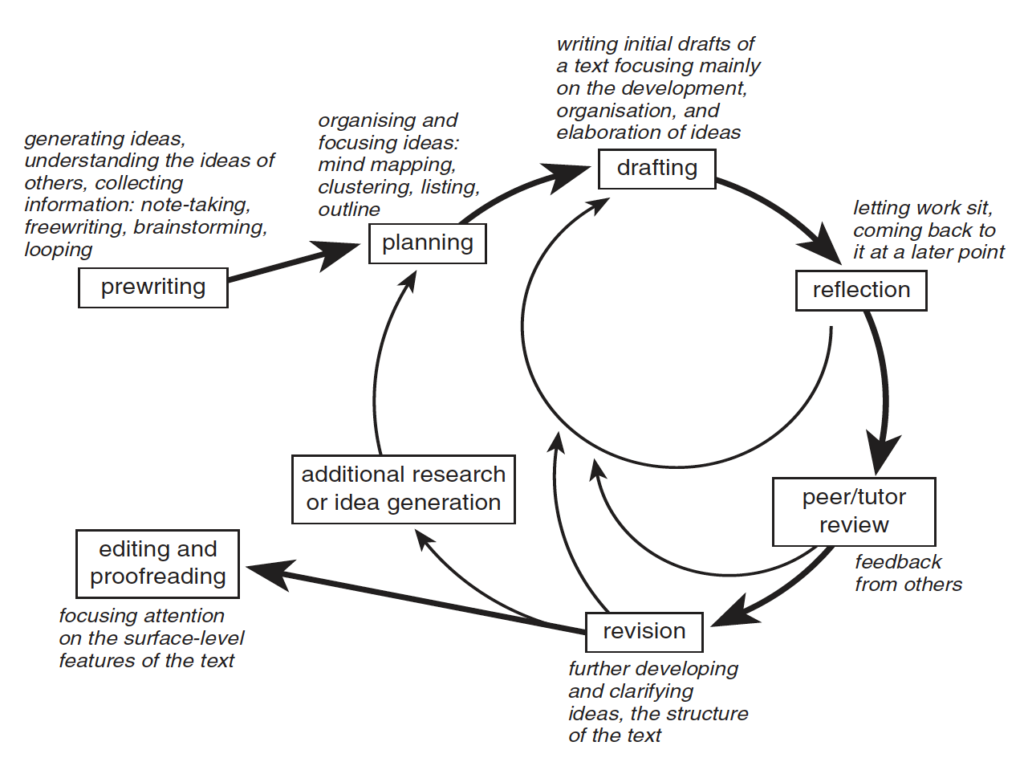
Presentation of Genre Features
| Engineering genre | Main purpose | Likely audience | Most important features |
|---|---|---|---|
| Research paper | Present original findings | Researchers and specialists | Methods, evidence, uncertainty, contribution |
| Technical report | Document an investigation or project | Engineers, managers, clients, regulators | Scope, procedures, results, conclusions |
| Design memorandum | Support a design decision | Project team or supervisor | Requirements, alternatives, calculations, trade-offs |
| Procedure or guide | Help someone complete a task | Operators, students, technicians | Ordered steps, warnings, diagrams, verification |
| Proposal | Obtain approval, funding, or resources | Managers, clients, sponsors | Need, objectives, plan, feasibility, cost |
| Presentation or poster | Communicate findings quickly | Mixed technical or public audiences | Visual hierarchy, concise claims, readable figures |
1. Begin with Purpose, Audience, and Decision
Before writing, decide what the document must accomplish and what the reader should be able to understand, verify, or decide afterward. A test report might determine whether a material meets performance requirements, while a design memorandum might recommend the best option among several alternatives. Keeping that decision visible prevents the document from becoming a collection of calculations without a clear point.
The structure should also match the purpose. Research papers often follow an introduction, methods, results, and discussion format. Design reports may move through requirements, alternatives, analysis, selection, and implementation. Procedures usually include prerequisites, numbered steps, warnings, troubleshooting, and verification. The goal is not to force every document into the same template but to choose a structure that makes the information easy for the intended reader to use (ASME, n.d.).

2. Present Technical Content That Can Be Checked
Engineering writing should make technical work traceable. Explain how results were produced by identifying the materials, equipment, software, assumptions, boundary conditions, and test conditions that affected the analysis. Define symbols when they first appear, use units consistently, and move long or repetitive calculations to an appendix when they would interrupt the main argument.
The NIST report Mechanical Properties Testing for Metal Parts Made via Additive Manufacturing provides a useful example. The authors clearly define the report’s scope and organize testing standards according to the properties they measure. Separating deformation tests from failure tests helps readers understand the engineering purpose of each method rather than simply presenting a long list of standards (Slotwinski et al., 2012).
Writers should also separate observation, interpretation, and recommendation. “Surface temperature increased as flow rate decreased” reports an observation. Saying that the trend “suggests reduced convective heat removal” interprets that observation. Recommending a minimum flow rate turns the interpretation into a decision. Keeping these stages distinct makes the reasoning easier to evaluate.
3. Organize Information in Layers
Engineering readers often scan documents before reading closely. Headings, abstracts, captions, tables, and summary statements should help readers locate important information quickly. An abstract or executive summary should identify the problem, approach, major result, and significance, while the body provides the evidence behind those claims. Appendices can hold supporting calculations, raw data, or documentation that matters but is not central to the main argument.
Layered organization also supports readers with different needs. A manager may focus on the summary and recommendation, while a technical reviewer may inspect assumptions and calculations. A technician may look mainly for procedures, warnings, and acceptance criteria.
Presentations and posters require even greater compression. A slide should normally communicate one main idea rather than reproduce an entire report page. Use short headings, readable graphics, and concise conclusions so the audience can understand the central claim while listening to the speaker.
4. Use Visuals as Evidence
Mechanical engineers use graphs, tables, schematics, CAD images, free-body diagrams, photographs, and process maps to make technical information easier to understand. Each visual should answer a specific question.
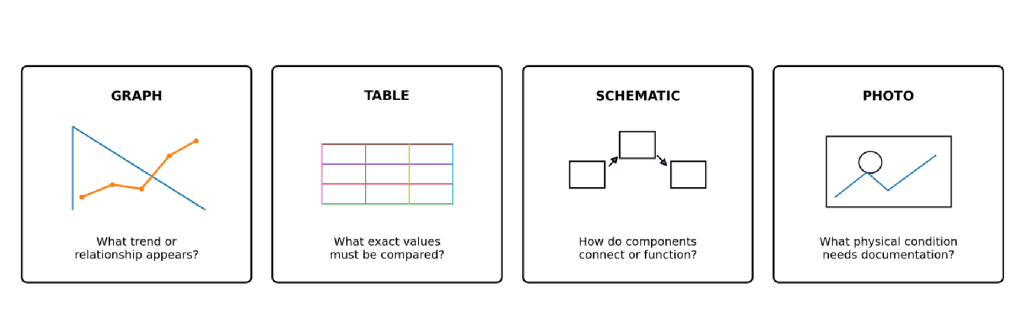
Use a graph when the reader needs to see a trend or relationship. Use a table when exact values must be compared. Use a schematic when the reader needs to understand components or connections, and use a photograph when physical conditions or damage need to be documented.
Every visual should include readable text, appropriate units, clear labels, and an informative caption. The surrounding paragraph should explain what the reader should notice and why the visual matters. A figure should not appear only to decorate the page or satisfy an assignment requirement.
Booth et al.’s Design for Additive Manufacturing Worksheet demonstrates how a visual can become part of the engineering method. Instead of merely illustrating the article, the worksheet helps users decide whether a component is suitable for additive manufacturing and where redesign may be needed (Booth et al., 2017).
5. Make Sources and Methods Traceable
Engineering work builds on standards, previous research, software, equations, drawings, and datasets. Cite borrowed information clearly, whether it comes from a testing method, material-property database, design standard, journal article, or reused visual. Citation style may vary by class, journal, company, or client. This guide uses APA style, while ASME publications frequently use numbered references.
Traceability also applies to the writer’s own work. Record specimen numbers, drawing revisions, calibration dates, software versions, and procedural changes. These details may seem minor during drafting, but they become essential when someone needs to reproduce a result, update a design, or investigate an error.
Engineering writers generally summarize sources rather than quoting them at length. Instead of inserting a quotation without explanation, describe how the source influenced the method, design decision, or interpretation.
6. Use Specialized Language Precisely
Technical terms are useful when they add precision. Words such as stress, strain, hardness, toughness, creep, and fatigue describe different properties or behaviors and should not be used interchangeably. Define acronyms when they first appear, and include a nomenclature list when a document contains many variables or symbols.
At the same time, avoid unnecessary jargon when writing for a mixed audience. A mechanical engineer may immediately understand yield strength, but a general reader may need a brief explanation before continuing.
Replace vague evaluations with measurable claims. Rather than saying that a material “performed better,” state that “heat treatment increased ultimate tensile strength by 12%.” Instead of saying a simulation “proved” that a design was safe, explain that “the model predicted stresses below the allowable limit under the specified loading conditions.”
7. Maintain an Objective, Readable Tone
Engineering writing should sound confident without claiming more than the evidence supports. Active voice can clarify responsibility: “We heated the specimens for two hours” directly identifies who performed the action. Passive voice remains useful when the process or result matters more than the person involved, as in “Temperature was measured at five locations.”
First person can also be appropriate when it improves clarity, especially in reports and reflections. However, conclusions should rest on evidence rather than personal opinion.
When evidence is limited, use language such as suggests, indicates, is consistent with, or within the tested range. Being honest about uncertainty makes technical writing more credible rather than less confident.
| Less credible wording | More credible wording |
|---|---|
| The material performed better. | Heat treatment increased ultimate tensile strength by 12%. |
| The simulation proved the design was safe. | The model predicted stresses below the allowable limit under the specified loading conditions. |
| The test was successful. | The specimen met the required load limit without visible cracking. |
8. Build Credibility Through Accuracy and Transparency
Before submitting an engineering document, check equations, units, dimensions, references, calculations, assumptions, and formatting. Also explain unexpected results and limitations. When a sensor fails, a specimen is removed, or a test condition changes, describe what happened and how it may have affected the findings.
Garcia and Cross’s NASA conference paper provides a strong example of traceability and transparency. Its abstract identifies the materials and manufacturing method, describes the operating conditions and measurements, and compares experimental results with a conventionally manufactured copper section and an analytical model. Readers can quickly see what was tested, how the experiment was conducted, and how performance was evaluated (Garcia & Cross, 2014).
9. Common Mistakes to Avoid
One common mistake is treating calculations as though they speak for themselves. Numbers still need context. Explain what each important result means, why it matters, and what decision it supports.
Another mistake is hiding assumptions. Conditions such as steady-state operation, constant temperature, ideal material behavior, or negligible friction can strongly affect a conclusion. Leaving them unstated makes the analysis appear more certain than it really is.
Writers also sometimes insert graphs or CAD images without discussing them. Every visual needs a caption and an explanation of what the reader should notice. Similarly, technical complexity should not be confused with strong writing. Dense sentences and excessive jargon can make accurate work harder to evaluate.
New writers can avoid many of these problems by creating headings before drafting paragraphs. The headings form a map of the document and reveal whether the organization makes sense. Revision should then happen in separate passes: first check organization and evidence, then visuals and citations, and finally sentence-level clarity and formatting.
10. Tips for New Engineering Writers
Start by asking, “What does my reader need to do with this information?” That question will help you decide what to include and what to leave out.
Write headings before drafting paragraphs. Headings create a map of the document and reveal whether the organization makes sense.
Use examples whenever a rule or concept might feel abstract. A short example can help a reader understand how to apply the advice.
Revise in separate passes. Check organization first, then evidence, then visuals, then sentence-level clarity, then formatting. Trying to fix everything at once makes revision harder.
Finally, remember that engineering writing is not just about sounding professional. It is about helping readers make informed decisions.
Final Mechanical-Engineering Writing Checklist
Before submitting, ask:
- Is the document’s purpose and required decision clear?
- Does the structure match the genre and intended audience?
- Are methods, assumptions, constraints, and test conditions identified?
- Are variables, acronyms, specialized terms, and units defined consistently?
- Are observations separated from interpretations and recommendations?
- Does every figure or table answer a useful question?
- Are axes, captions, legends, units, and sources complete?
- Are standards, articles, software, datasets, and reused visuals traceable?
- Are uncertainty, limitations, failed tests, and unexpected findings acknowledged?
- Do the conclusions follow directly from the evidence?
- Could a presentation or summary communicate the main finding more concisely?
- Has another person reviewed both the calculations and the writing?
References
American Society of Mechanical Engineers. (n.d.). Writing a research paper or
Booth, J. W., Alperovich, J., Chawla, P., Ma, J., Reid, T. N., & Ramani, K. (2017).
The design for additive manufacturing worksheet. Journal of Mechanical
Design, 139(10), Article 100904.
Garcia, C. P., & Cross, M. (2014, September 3-5). Additive manufacturing thermal
performance testing of single channel GRCop-84 SLM components
[Conference paper]. JANNAF Additive Manufacturing Technical Information
Meeting, Huntsville, AL.
NASA Scientific and Technical Information Program. (n.d.). Writing resources and
Purdue Online Writing Lab. (n.d.). Writing engineering reports. Purdue University.
Slotwinski, J., Cooke, A., & Moylan, S. (2012). Mechanical properties testing for
metal parts made via additive manufacturing: A review of the state of the art
of mechanical property testing (NISTIR 7847). National Institute of Standards
and Technology.
 Ashton Petersen
Leave a comment